
Digital Member Systems and Union Data Security: What Organizers Need to Know Before Going Digital
Every union digital organizing platform stores names, addresses, phone numbers, employer information, and authorization signatures. A breach of that data hands management a complete map of your organizing committee. These six rules protect your members and your campaign.
Digital Member Systems and Union Data Security: What Organizers Need to Know Before Going Digital
Every union digital organizing platform stores names, addresses, phone numbers, employer information, and authorization signatures. A breach of that data hands management a complete map of your organizing committee. These six rules protect your members and your campaign.
Audit every data field before you choose a platform
The biggest security risk in organizing software implementation isn't hackers. It's collecting information you don't need. Every unnecessary field you fill out becomes a liability if the system is compromised, subpoenaed, or accessed by someone who shouldn't have it.
The UC Berkeley Labor Center's research on data rights and access confirms that unions have increasingly negotiated provisions ensuring workers can "exercise control over how their personal data is used." That principle starts before the first login screen. If a platform asks you to enter members' Social Security numbers, immigration status, disciplinary history, or medical information, you need a documented reason for each field. Otherwise, don't enter it.
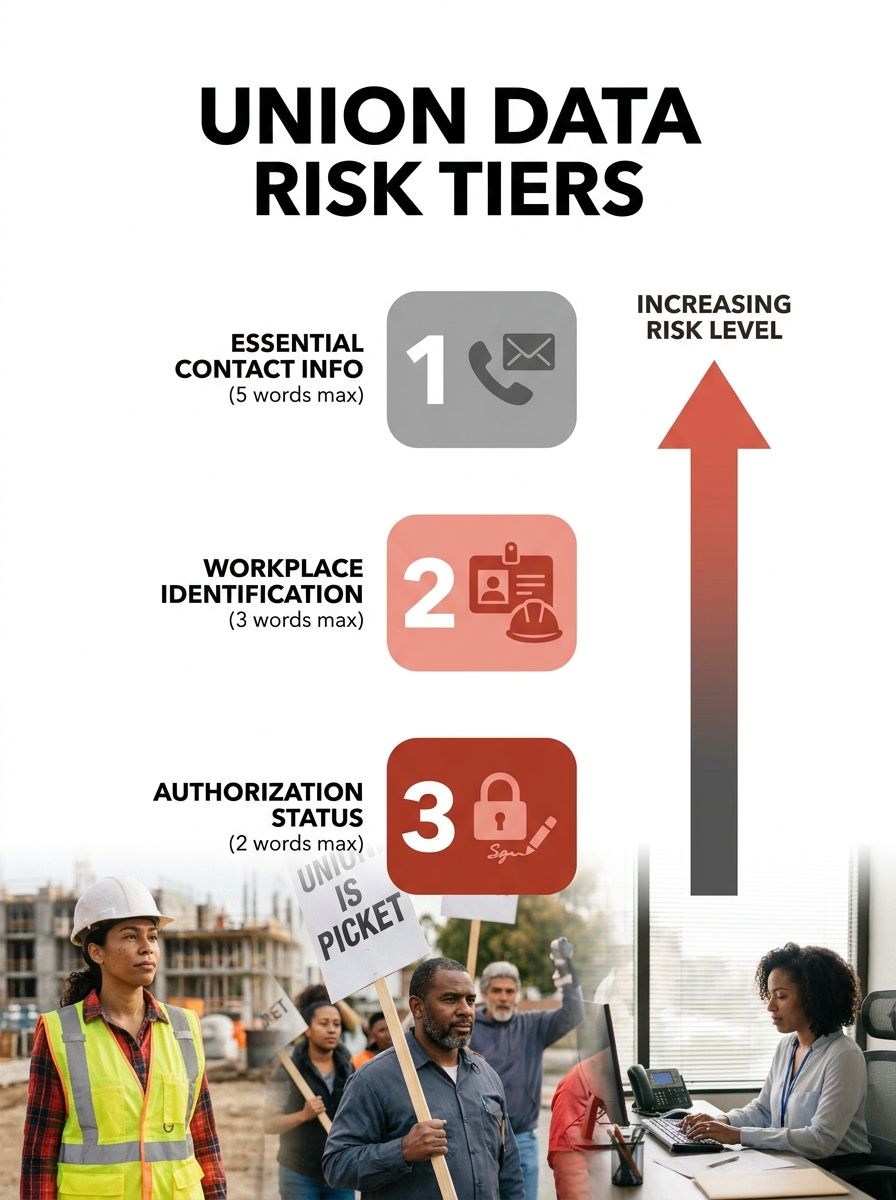
Run a data minimization audit before you sign any vendor agreement. Map out exactly what you need for three functions: contact (name, phone, email), workplace identification (employer, job classification, shift), and authorization status (card signed yes/no, date). Anything beyond those categories requires justification written into your local's data governance policy.
This matters for legal exposure too. Under CCPA/CPRA, California-based unions handling member data must maintain data inventories and respond to individual access requests. GDPR imposes similar obligations for unions with international membership. According to Glue Up's compliance analysis, platforms that support encryption, consent management, and data subject rights reduce the administrative burden of meeting these requirements. But the simplest compliance strategy remains collecting less data in the first place.
Demand encryption specifications in the contract, not the brochure
Marketing pages for digital union tools love the word "secure." That word means nothing without specifications. When comparing platforms for member data security, you need to verify three specific things: encryption in transit, encryption at rest, and certificate strength.
Union Impact Software, one of the union-specific platforms on the market, specifies that connections are encrypted with HTTPS (SSL/TLS) using 2048-bit certificates. That's a concrete, verifiable standard. If a vendor can't tell you their certificate bit length, their TLS version, or whether data is encrypted at rest on their servers, walk away.
SOC 2 Type II compliance has become the baseline expectation for any platform handling sensitive organizational data. This standard requires third-party auditors to verify that a vendor's security controls actually function over time, not just that they exist on paper. Ask every vendor three questions before signing: Are your data centers SOC 2 Type II audited? Do you store each client's data on dedicated servers or shared infrastructure? Where are the physical servers located?
That last question matters more than organizers realize. Data sovereignty laws vary by country and, increasingly, by state. Canadian locals need Canadian-hosted data. A platform that stores everything on a single U.S. server farm creates jurisdictional complications for international unions.
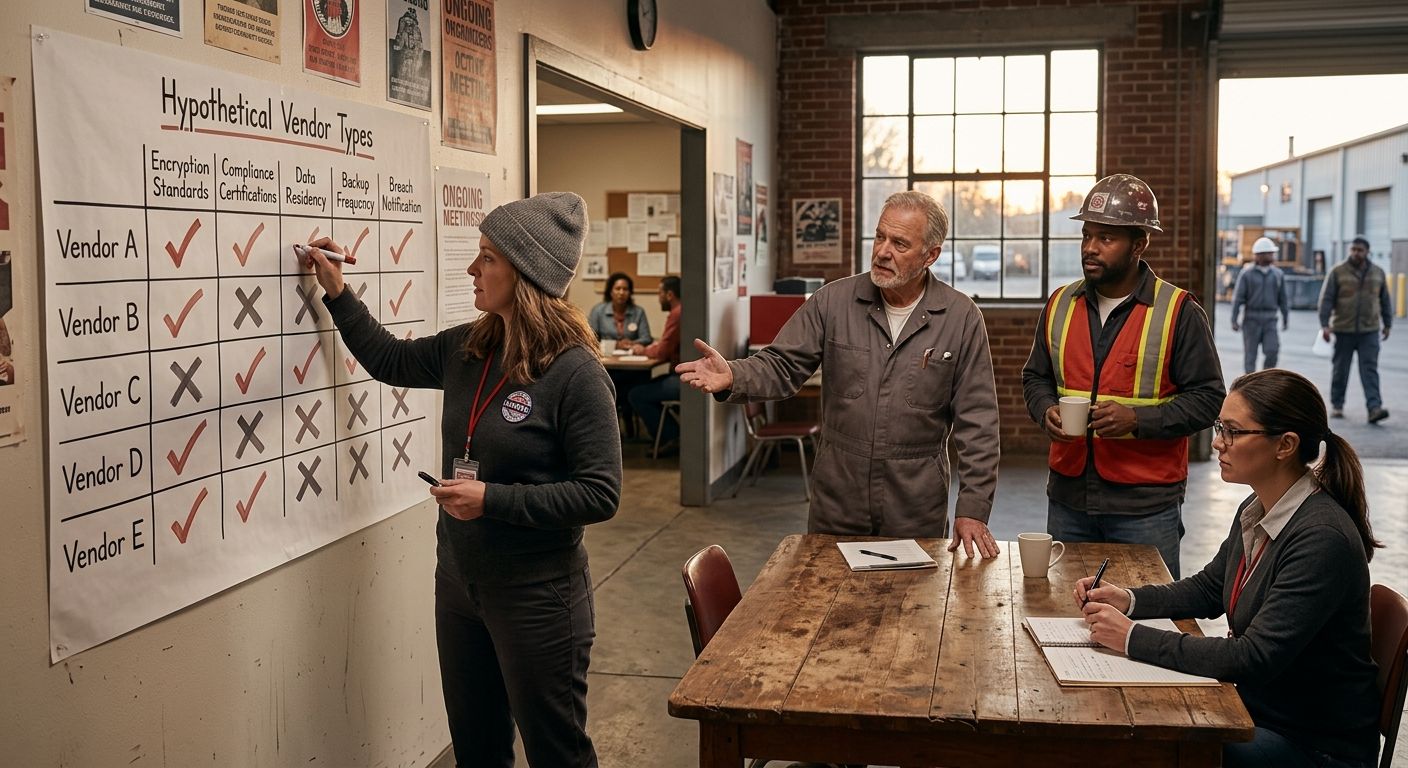
When doing a digital union tools comparison, build a scoring sheet. Rate each platform on: encryption standards (documented, not claimed), compliance certifications (SOC 2, ISO 27001), data residency options, backup frequency, and breach notification timelines. Platforms that score well on marketing language but can't produce audit documentation should be eliminated immediately.
Treat access permissions like shop floor seniority rights
Who can see what inside your digital member system determines whether a compromised password exposes ten records or ten thousand. Role-based access control should mirror the same principle unions already understand from the shop floor: people get access to what their role requires, and nothing more.
A chief steward needs to see grievance files for their unit. A volunteer phone banker needs names and numbers for their call list. The local's treasurer needs dues records. None of these people need access to authorization card scans, and the phone banker has no business seeing grievance details. Build these walls into the system from day one.
Multi-factor authentication is the single cheapest security upgrade any local can implement. According to the cybersecurity guidance published by Member Resources, unions should implement MFA to secure access to member data, alongside regular software updates to patch known vulnerabilities. MFA means that even when a steward's password gets phished, the attacker still can't log in without the second verification step.
The practical challenge is adoption. Organizers working long hours on campaigns resist adding steps to their login process. Combat this by choosing platforms that support authenticator apps rather than SMS-based codes (SMS is vulnerable to SIM-swapping attacks) and by making MFA enrollment part of the initial system training, not an afterthought.
Review access logs monthly. Any system worth using produces audit trails showing who accessed which records and when. If you notice a pattern of access that doesn't match someone's role, address it immediately. The organizing model we've written about in our comparison of organizing and service approaches depends on distributed leadership, but distributed leadership with unchecked data access is a vulnerability waiting to be exploited.
Assume management monitors your digital perimeter
Employer surveillance of union activity is accelerating, and the legal framework is scrambling to keep up. The NLRB signed memoranda of understanding with the Department of Labor, the Department of Justice, the FTC, and the Consumer Financial Protection Bureau, all aimed at protecting employees from invasive monitoring practices. In March 2023, the NLRB also announced a partnership with the CFPB to address employer surveillance, monitoring, and data collection in the workplace.
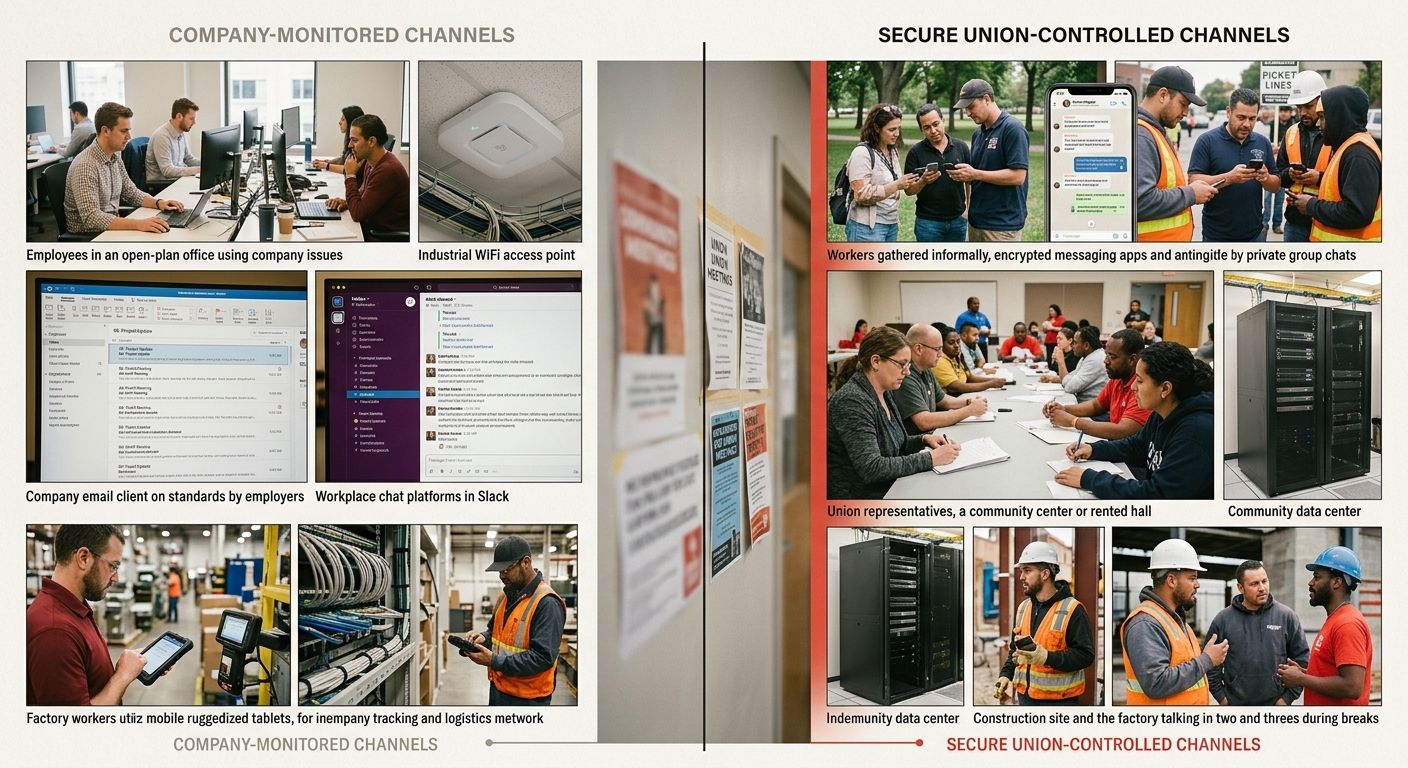
These partnerships signal that federal regulators recognize the problem. But recognition and enforcement are different animals. Right now, employers routinely monitor company email, Slack channels, network traffic, and even personal devices connected to workplace Wi-Fi. If your organizing committee communicates through any employer-owned system, assume that communication is being read.
The UC Berkeley Labor Center's research on data-driven workplace technologies calls for new rights and protections "to ensure worker dignity and welfare in the use of data-driven technologies in the workplace," including standards that "protect the right to organize." Until those protections exist in statute, organizers must protect themselves.
Practical translation for worker privacy and unions: use personal devices on personal data plans for all organizing communication. Choose platforms with end-to-end encryption for messaging. Store authorization cards on union-controlled servers, never on cloud storage tied to employer-provided accounts. And train your committee members on these protocols during their first organizing meeting, using the kind of structured education approach that prevents weak links from forming.
The billion-dollar union-busting consulting industry actively searches for information about organizing committees. Every data point you leave on an employer-accessible system is intelligence you're handing to the other side for free.
Negotiate data rights directly into the collective bargaining agreement
Worker data protections shouldn't depend entirely on a software vendor's privacy policy. They belong in the contract. UC Berkeley's research documents a growing trend: unions negotiating provisions that give workers the ability to "access, review, and challenge information collected about them" by employers using digital systems.
These provisions typically address three areas. First, transparency about what data the employer collects, how it's stored, and who can access it. Second, the right to review and correct personal data held by management. Third, limits on how algorithmic systems can use worker data for discipline, scheduling, or performance evaluation.
But there's a fourth area that most locals neglect: protections for union-held data itself. Your CBA should include clauses that prevent management from subpoenaing union membership databases during contract disputes, that establish the union's right to maintain its own secure communication channels on employer premises, and that prohibit the employer from using workplace surveillance data to identify union supporters.
If your local is heading into first contract negotiations, data rights should be on the proposals list alongside wages and benefits. The precedent you set in the first contract shapes every negotiation that follows.
Never store authorization cards alongside active membership rolls
This rule sounds paranoid until you think through the breach scenario. Authorization cards contain signatures, dates, and explicit declarations of union support. Active membership rolls contain dues status, contact information, and often personal identifiers. If both datasets live in the same system and that system is compromised, the attacker gets a complete picture: who supports the union, who signed a card, who's paying dues, and how to reach every one of them.
Separate these systems. Authorization card scans should be stored in a restricted-access, encrypted archive that only designated officers can reach. Active membership management happens in a different system or, at minimum, a completely separate database partition with its own access controls and its own encryption keys.
This separation also protects the union during NLRB election disputes. If management challenges the validity of authorization cards, you want those cards stored in a system with clear chain-of-custody documentation. A platform that commingles card scans with routine membership data makes it harder to demonstrate that cards were collected, stored, and maintained properly. Organizers who've worked through the 30% authorization card threshold know how much rides on the integrity of those documents.
Backup protocols should also be separated. Nightly off-site backups of membership rolls go to one secure location. Authorization card archives go to another. If ransomware hits one system, the other remains intact and recoverable.
When These Rules Contradict Each Other
Security and accessibility pull in opposite directions. Stricter access controls slow down organizers who need information fast during a heated campaign. Separating data systems adds complexity that small locals with volunteer-run operations struggle to maintain. Encrypting everything makes it harder to search records or generate quick reports for a steward who needs numbers before a shift meeting.
These tensions are real, and pretending otherwise insults the organizers doing this work. The answer isn't to abandon security for convenience or to lock systems down so tightly that nobody uses them. The answer is to build your security architecture around your actual campaign operations, not around a theoretical ideal.
Start by identifying the three highest-risk moments in your organizing cycle. For most locals, those moments are: the period between card collection and election filing, the weeks surrounding an NLRB election, and the first contract negotiation window. During those windows, tighten access controls, increase audit log reviews, and limit who handles sensitive data. Between those windows, you can operate with slightly looser protocols while still maintaining baseline encryption and MFA.
The UC Berkeley Labor Center's framework for worker technology rights points toward a future where these protections are embedded in law, where organizers don't have to be their own cybersecurity team. That future isn't here yet. Until it arrives, every local that goes digital is responsible for building its own defenses. The rules above won't stop every threat, but they address the failure modes that have already cost real unions real campaigns. The work of protecting your members' data is the work of protecting your members, and it deserves the same seriousness as every other part of building grassroots campaigns from the ground up.
The Union Edge Staff
Related Articles

The Privacy-First Organizing Playbook: How Unions Can Build Secure Digital Campaigns Without Compromising Security
Hospital and clinic networks run some of the most sophisticated internal surveillance systems of any employer in the country, and that infrastructure, originally justified by HIPAA compliance and patient safety, gives healthcare management an unusual capacity to monitor the very same digital channel

From Data Silos to Member Intelligence: Building a Union Organizing Database That Actually Drives Campaigns
The NLRB requires a 30% showing of interest before scheduling a union election, and organizers need 50% plus one vote to win. Those two numbers define every campaign's math.

Union Organizing Software vs. Digital Organizing Tools: Choosing the Right Tech Stack for Your Campaign
Union organizing software and general digital organizing tools serve fundamentally different purposes, and picking the wrong one can expose worker data, slow your campaign timeline, and fracture member engagement.
Also in the paper