
The Captive Audience Meeting Playbook: How Employers Script Anti-Union Campaigns and What the Research Says About Their Effectiveness
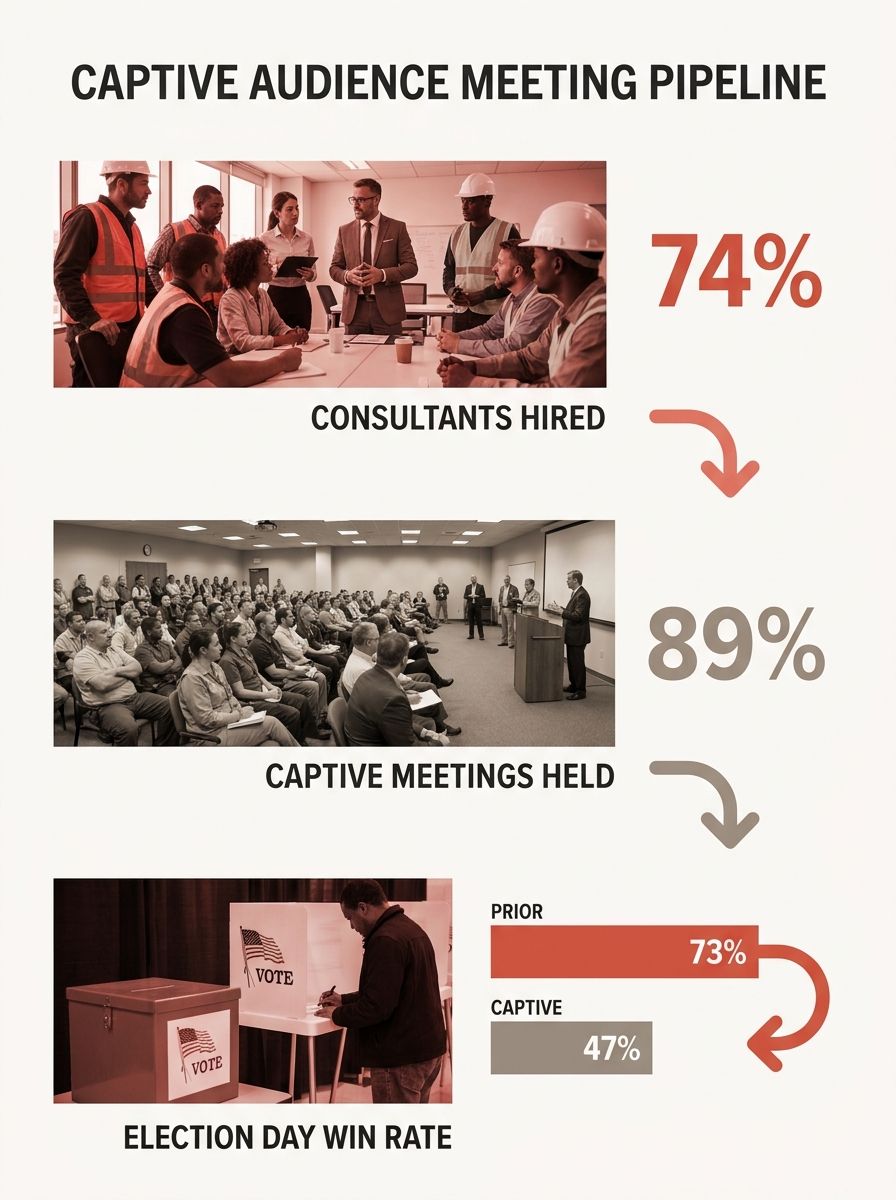
Captive audience meetings are deployed in roughly 89% of union organizing campaigns in the United States, and the data shows they cut union election win rates from 73% to 47%.
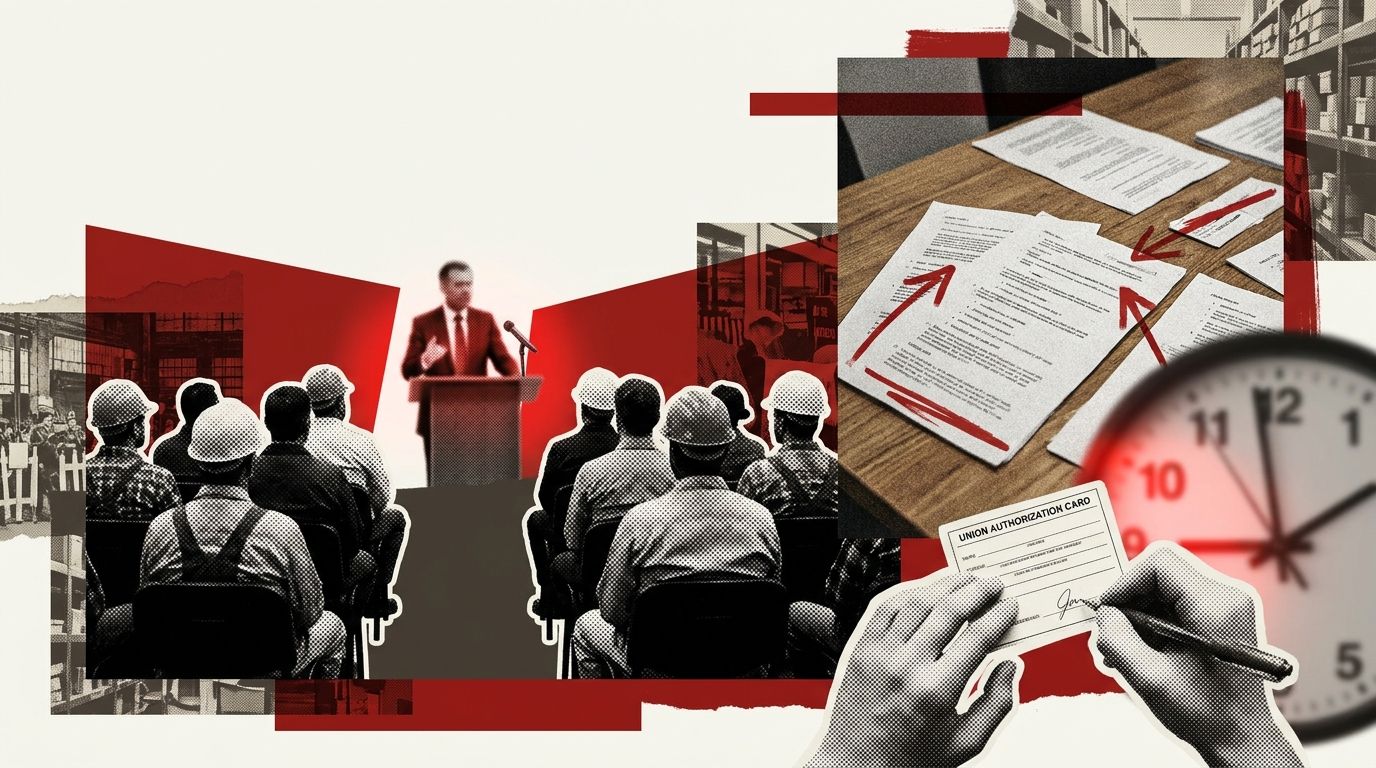
The Captive Audience Meeting Playbook: How Employers Script Anti-Union Campaigns and What the Research Says About Their Effectiveness
Captive audience meetings are deployed in roughly 89% of union organizing campaigns in the United States, and the data shows they cut union election win rates from 73% to 47%. These mandatory anti-union meetings, held on company time with attendance enforced by supervisors, represent the single most effective employer anti-union tactic documented in labor research. The NLRB banned them in November 2024, but that ban is already under legal attack.
How the Meetings Work
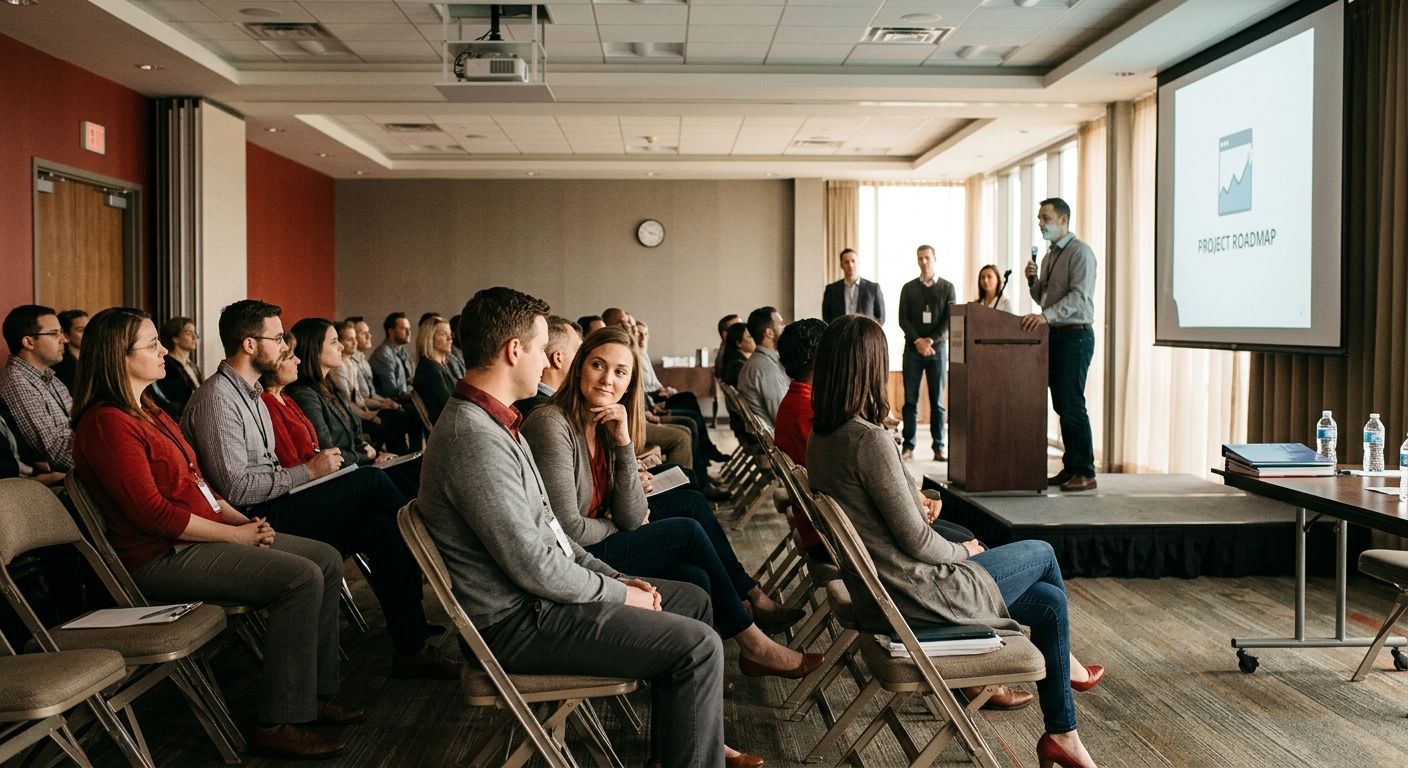
Employers schedule captive audience meetings during paid work hours, typically in conference rooms or break areas, and require attendance the same way they'd require attendance at a safety briefing or a shift meeting. Workers who refuse to attend can be disciplined or fired. The meetings are led by managers, HR staff, or outside consultants and follow tightly scripted talking points designed to discourage employees from signing union authorization cards or voting yes in an NLRB election.
The scripts follow a predictable pattern. Management presents the union as a third-party outsider that will collect dues, make promises it can't keep, and introduce conflict into a previously harmonious workplace. Supervisors read from prepared materials that frame collective bargaining as a gamble: wages and benefits could go up, stay the same, or go down during negotiations. The phrasing is calibrated to sound neutral while planting doubt.
Kate Bronfenbrenner, director of labor education research at Cornell University's ILR School, testified before Congress that 74% of employers hire one or more management consultants to run these anti-union campaigns. These consultants draft the scripts, coach supervisors on delivery, and coordinate the timing of meetings to maximize psychological impact during the critical weeks before an election. Employers collectively spend more than $400 million annually on union-avoidance consultants who specialize in this work, part of a broader $1.7 billion anti-union industry that has grown steadily alongside rising worker interest in organizing.
The Script's Anatomy
Why do these meetings swing elections so dramatically? The answer lies in how the scripts exploit the power imbalance already present in any workplace.
A typical captive audience meeting script moves through four phases. First, the emotional appeal: management expresses concern for employees, thanks them for their hard work, and frames the meeting as an opportunity to "share information." Second, the fear stage: the script raises the specter of strikes, lost income, and the possibility that the union could negotiate a contract worse than current conditions. Third, the isolation play: the employer emphasizes that workers don't need a "third party" to communicate with management, implying that pro-union coworkers are being manipulated by outsiders. Fourth, the personal appeal: supervisors are coached to speak one-on-one with workers after the group meeting, asking them directly whether they've signed a union authorization card.
This fourth phase is where the coercion becomes most intense. Workers are pulled aside individually by their direct supervisors, the people who control their schedules, approve their time off, and write their performance reviews. The union authorization card becomes a litmus test. Workers who admit to signing one are tagged for additional "education." Workers who deny it feel the implicit threat of being watched.
An NLRB case study analysis found that even where legal restrictions existed on specific employer actions during campaigns, "the penalties for violations are so meager that they serve no deterrent effect," according to a report on patterned anti-union responses published by the Board. A supervisor who illegally interrogates a worker about their union sympathies faces, at worst, a posting requirement and a cease-and-desist order months or years later. By then, the election is long over.
The NLRB's November 2024 Ban and Its Uncertain Future
The NLRB ruled in November 2024, in a case involving Amazon.com Services, LLC, that mandatory captive audience meetings violate Section 8(a)(1) of the National Labor Relations Act. The Board overturned 75 years of precedent set by the 1948 Babcock & Wilcox Co. decision, which had permitted employers to require attendance at anti-union presentations as long as they didn't contain explicit threats.
The Board's reasoning was direct: compelling workers to attend meetings where their employer argues against unionization "has a reasonable tendency to interfere with and coerce employees in the exercise of their Section 7 rights." The ruling recognized what workers have known for decades, that being forced to sit in a room while your boss explains why a union would be bad for you is coercive by its nature, regardless of the specific words used.
But the NLRA captive audience ban is already in jeopardy. The Trump administration's NLRB General Counsel issued GC Memo 25-05, rescinding the previous General Counsel's enforcement guidance and seeking to reverse the ban entirely. The Amazon ruling itself is pending appeal before the U.S. Court of Appeals for the Eleventh Circuit. If the court overturns the decision, or if a reconstituted NLRB reverses it through a new case, employers will regain the explicit legal authority to require attendance at anti-union meetings.
This legal whiplash is familiar territory. Workers who want to understand how to respond when employer tactics cross the line should know how to file an unfair labor practice charge, because the formal complaint process remains the primary enforcement mechanism regardless of which way the captive audience ruling goes.
Twelve States Have Built Their Own Protections
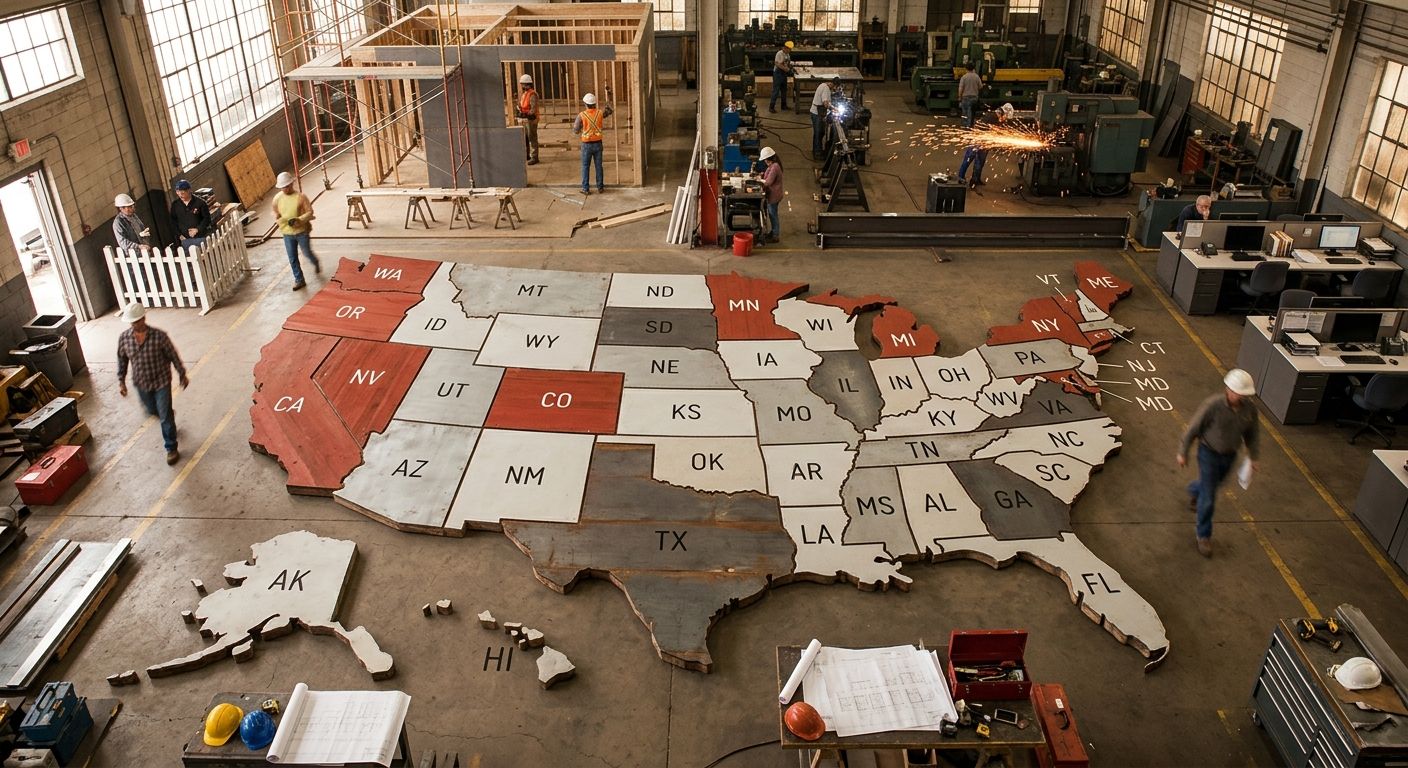
The federal uncertainty has pushed state legislatures to act. Twelve states now ban or restrict captive audience meetings on political, religious, or union-related topics: California, New York, Illinois, Washington, Oregon, Alaska, Connecticut, Hawaii, Maine, Minnesota, New Jersey, and Vermont.
California's SB 399, which took effect on January 1, 2025, prohibits employers from taking adverse action against workers who refuse to attend meetings where the employer communicates opinions on political or religious matters, including unionization. The law doesn't prevent employers from holding the meetings; it prevents them from punishing workers who walk out or refuse to show up. That distinction matters. An employer in Sacramento can still schedule a mandatory anti-union meeting. What they can't do is fire or discipline the warehouse worker who stays at her station instead of attending.
SB 399 faces federal lawsuits challenging its constitutionality under both the First Amendment and NLRA preemption, the argument that federal labor law occupies the field and leaves no room for state regulation. These legal challenges will take years to resolve. In the meantime, workers in those 12 states have protections that workers in the remaining 38 do not.
State | Law/Statute | Key Protection |
|---|---|---|
California | SB 399 (2025) | No adverse action for refusing attendance |
New York | Labor Law §201-d expansion | Employer cannot require attendance on political/union topics |
Oregon | SB 519 (2010) | Earliest state-level ban; covers employer meetings on political/religious matters |
Illinois | Worker Freedom of Speech Act | Prohibits mandatory meetings on political/union matters |
Minnesota | Employee Protection Act | Workers may refuse attendance without retaliation |
Connecticut | Captive Audience Ban (2022) | Covers religious, political, and union-related meetings |
Washington | HB 1491 | Bars retaliation for refusal to attend |
The Economic Policy Institute noted that the NLRB ruling makes "these egregious, widespread abuses of employer power illegal" in the context of worker organizing, but also urged states to continue broadening protections. The EPI's position reflects a hard-earned skepticism: federal labor protections granted by one NLRB can be revoked by the next.
How Organizers Counter the Playbook
Experienced union organizers don't wait for captive audience meetings to happen and then react. They prepare workers in advance through a strategy called inoculation: exposing workers to the exact arguments management will use before management uses them.
The inoculation approach works because captive audience meeting scripts are remarkably standardized. When 74% of employers hire outside consultants, and those consultants draw from the same playbook, the arguments become predictable. Organizers walk workers through the likely talking points: "They'll tell you the union is an outside third party. They'll say your dues money goes to union bosses. They'll say you could lose benefits during negotiations. They'll bring up strikes." When workers hear those arguments for the first time in a captive audience meeting, the impact is significant. When workers have already heard the arguments previewed and debunked by their coworkers, the meeting loses its persuasive force.
The data supports this. The 73%-to-47% win rate drop associated with captive audience meetings reflects campaigns where workers encounter these arguments without preparation. Campaigns that run structured organizing models with inoculation programs report substantially better outcomes, because the element of surprise is gone.
Organizers also advise workers to verify their state-specific rights before a captive audience meeting is scheduled. In any of the 12 states with bans, workers can refuse attendance without legal consequence. Workers in states without protections who believe a meeting crossed into threats or interrogation can still file charges. The distinction between lawful "predictions" (saying a union could lead to a strike) and unlawful "threats" (saying the plant will close if workers unionize) is narrow, and employers routinely step over it.
The union authorization card itself plays a strategic role in countering captive audience meetings. When a supermajority of workers (65-70% or more) have signed cards before management launches its campaign, the captive audience meetings have less room to erode support below the 50%+1 threshold needed to win the election. Organizers who understand the union authorization card impact on election outcomes build larger margins specifically because they know the employer's counter-campaign will shave 15-25 percentage points off initial support.
The Open Threads
The legal status of captive audience meetings will remain unsettled for at least another 12 to 18 months. The Eleventh Circuit could uphold the NLRB's Amazon ruling, strike it down, or send it back to the Board for reconsideration. A reconstituted NLRB under the current administration could overturn the decision through a future case without waiting for the courts. And the 12 state-level bans face their own constitutional challenges that will work through federal courts on separate timelines.
What the research has settled, though, is the effectiveness question. Captive audience meetings work for employers because they exploit a structural advantage: the employer controls the space, the time, the audience, and the consequences for dissent. The 89% deployment rate reflects rational behavior by employers and their consultants. When a tactic cuts your opponent's win rate by 26 percentage points, you use it in every campaign.
The open question is whether the legal system will treat that structural coercion as what it is, or whether it will continue to treat a boss requiring workers to sit through an anti-union presentation as an exercise of free speech. The answer depends on which judges hear which cases, which political appointees sit on the NLRB, and whether state legislatures continue to fill the gaps that federal law leaves open. Workers watching this space should pay attention to the Eleventh Circuit's timeline and to their own state legislature's calendar. The broader pattern of employer spending on union avoidance shows no sign of slowing down, and the playbook will keep running as long as the law permits it.
The Union Edge Staff
Related Articles
When Employers Fight Back: Recognizing and Countering Union-Busting Tactics During Your Organizing Campaign
U.S. employers are charged with violating federal law in 41.5% of all union election campaigns, according to a study from the Economic Policy Institute. The violations follow a predictable script.
NLRB: What Employers and Employees Need to Know
The National Labor Relations Board is the independent federal agency that decides whether your employer broke the law when it fired you for talking about wages, interrogated you about a union meeting, or refused to bargain after workers voted to organize.
The PRO Act Is Dead Again — and Labor's Legislative Strategy Needs a Hard Reset
The Richard L. Trumka Protecting the Right to Organize Act has been introduced in four consecutive Congresses. It passed the House once, never reached a Senate floor vote, and changed zero lines of federal labor law.
Also in the paper